
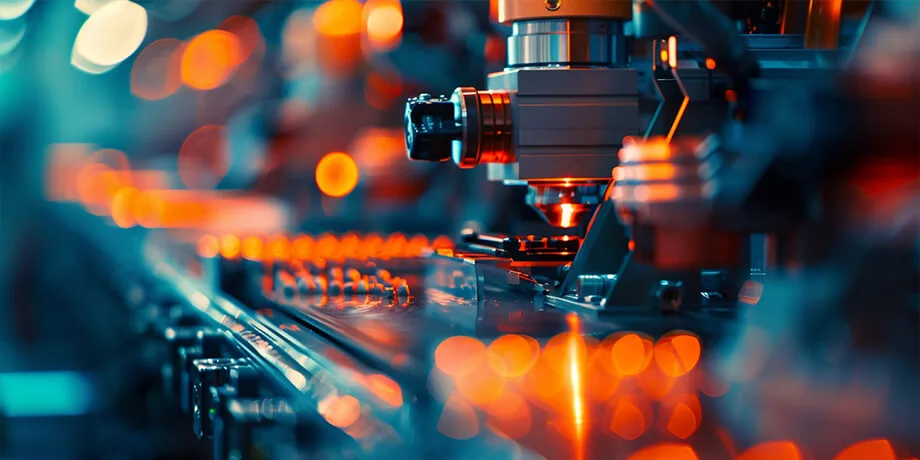
Robotics, or robotisation, means that work is carried out by robots instead of by people. In manufacturing this has long been the case for welding, spraying and packaging, and it is spreading to assembly, inspection and logistics on the shop floor. The question is no longer whether robots play a role in quality control, but how you organise that role.
This article sets out which robots you come across in production, what they do for quality and safety, where the drawbacks lie and what it means for your quality management.
Which robots do you come across in production?
Production robots come in roughly three well-known forms:
- Point-to-point robots. The most common robot in manufacturing, usually used for tasks such as welding: the arm moves from point to point and performs the same action at each point.
- Pick-and-place robots. This robot has three axes of movement and picks up objects to put them down in a specific place. Packaging and assembly are typical tasks.
- Cartesian robots. They move along straight axes (x, y, z) and can therefore be used for many purposes: welding, assembly, packaging, but also measuring and inspection.
In addition, you increasingly see cobots: robots that work alongside people without guarding, for tasks that are too repetitive for a person but too variable for a fully automated line.
What does robotics deliver for quality?
A robot is a substantial investment. That is why you want to know not only which robot suits your process, but also what it delivers compared with the alternatives and what the financial consequences are. Four benefits keep coming back.
Higher productivity
Robots weld, assemble and fabricate without a break. Production lines speed up and daily output rises. A robot can keep working 24 hours a day, something you cannot and do not want to ask of an employee.
For quality control, this also means you can check more. Where a sample was the maximum, an inspection robot can measure every product. Deviations stand out sooner and you have data on every item instead of on a selection.
Consistent quality
For many companies, maintaining product quality is still a reason to postpone robots. There is uncertainty, and not everyone trusts the quality of robot work one hundred per cent. That is a missed opportunity, because robots are strong precisely in quality control.
A robot performs the same action with the same accuracy every time. Where a person misses a small deviation after six hours of concentration, a robot does not. In sectors where small errors have big consequences, such as medical equipment or automotive, that consistency is exactly what a quality manager is looking for. The condition is that the robot is properly programmed and calibrated; a robot also makes a mistake consistently.
More flexibility
The market changes quickly. Trends come and go, and customers want what is new straight away. That calls for flexible product development where traditional methods sometimes fall short. Instead of redesigning and rebuilding equipment, you program a robot for a new series of tasks.
Want to make a new product? Then you adjust the task sequence and the robot gets back to work. Production lines can therefore be adapted quickly to changing demand, without the quality control having to be set up again.
More safety
Accidents still happen in production environments every year. By automating dangerous, heavy or repetitive tasks, you considerably reduce the risk of injury to employees. Welding, lifting, working with hot or sharp materials: precisely the tasks robots are good at.
In summary: robots provide consistency, increase production speed and make setting up new lines more flexible. That leads to fast delivery of reliable products to satisfied customers, and with it to turnover and stability.
Are there drawbacks too?
So many benefits without drawbacks is not possible. The biggest drawback, and for many companies a potential dealbreaker, is the purchase price. On top of that come costs for integration, programming, maintenance and training of the people who have to work with the robot. For smaller series, the payback period can be long.
There is also an organisational side. A robot changes the work of the people around it. Operators become programmers and supervisors, and the quality inspector works with measurement data instead of the naked eye. If you do not guide that change, you buy an expensive machine that runs below its capabilities.
What does this mean for your quality management?
Robotics changes not only production, but also what you record in your quality management system (QMS). The work instruction for a manual weld seam becomes a program with parameters, a calibration schedule and a maintenance record. The sampling instruction becomes a measurement plan with tolerances. And the deviations the robot registers must land somewhere where someone assesses and follows them up.
That is the place of the quality management system: keeping the work instructions, calibrations and maintenance records up to date, with an owner, and linking the reports from the line to improvement actions. You can read how quality control in manufacturing works more broadly in Quality control in manufacturing.
Robotics or not?
For companies that have embraced robotics, the results are convincing: more efficiency and productivity, but also better product quality and a safer shop floor. The upfront investment is high, sometimes too high for the current series size. But the benefits are clear: optimised processes, flexible production and satisfied customers.
Start small. Choose one task that is repetitive, measurable and error-prone, for example an inspection step, and calculate what a robot would deliver there in rejects and rework. That figure is a better basis for the decision than the supplier's brochure.
Also read Industry 4.0: the transformation of quality management in manufacturing and Zero defects: how manufacturing strives for perfection.